
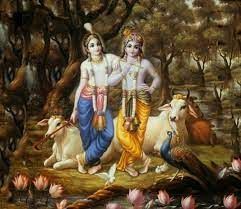
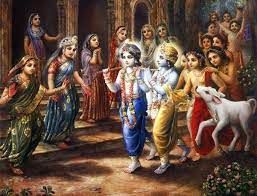
Lord Balarāma became very anxious to see His father and mother, Mahārāja Nanda and Yaśodā. Therefore, He started for Vṛndāvana on a chariot with great enthusiasm. The inhabitants of Vṛndāvana had been anxious to see Kṛṣṇa and Balarāma for a very long time. When Lord Balarāma returned to Vṛndāvana, all the cowherd boys and the gopīs had grown up; but still, on His arrival, they all embraced Him, and Balarāma embraced them in reciprocation. After this He came before Mahārāja Nanda and Yaśodā and offered His respectful obeisances unto them. In response, mother Yaśodā and Nanda Mahārāja offered their blessings unto Him. They addressed Him as Jagadīśvara, or the Lord of the universe who maintains everyone. The reason for this was that both Kṛṣṇa and Balarāma maintain all living entities, and yet Nanda and Yaśodā were put into such difficulties on account of Their absence. Feeling like this, they embraced Balarāma and, seating Him on their laps, began their perpetual crying, wetting Balarāma with their tears. Lord Balarāma then offered His respectful obeisances to the elderly cowherd men and accepted the obeisances of the younger cowherd men. Thus, according to their different ages and relationships, Lord Balarāma exchanged feelings of friendship with them. He shook hands with those who were His equals in age and friendship, and with loud laughing embraced each one of them.
After being received by the cowherd men and boys, the gopīs, and King Nanda and Yaśodā, Lord Balarāma sat down, feeling satisfied, and they all surrounded Him. First Lord Balarāma inquired from them about their welfare, and then, not having seen Him for such a long time, they began to ask Him different questions. The inhabitants of Vṛndāvana had sacrificed everything for Kṛṣṇa, simply being captivated by the lotus eyes of the Lord. Because of their great desire to love Kṛṣṇa, they never desired anything like elevation to the heavenly planets or merging into the effulgence of Brahman to become one with the Absolute Truth. They were not even interested in enjoying a life of opulence, but were satisfied in living a simple life in the village as cowherd men. They were always absorbed in thoughts of Kṛṣṇa and did not desire any personal benefits, and they were all so much in love with Him that in His absence their voices faltered when they began to inquire from Balarāmajī.
First Nanda Mahārāja and Yaśodāmayī inquired, “My dear Balarāma, are our friends like Vasudeva and others in the family doing well? Now You and Kṛṣṇa are grown-up married men with children. In the happiness of family life, do You sometimes remember Your poor father and mother, Nanda Mahārāja and Yaśodādevī? It is very good news that the most sinful King Kaṁsa has been killed by You and that our friends like Vasudeva and the others who had been harassed by him, have now been relieved. It is also very good news that both You and Kṛṣṇa defeated Jarāsandha and Kālayavana, who now is dead, and that You are now living in a fortified residence in Dvārakā.”
When the gopīs arrived, Lord Balarāma glanced over them with loving eyes. Being overjoyed, the gopīs, who had so long been mortified on account of Kṛṣṇa’s and Balarāma’s absence, began to ask about the welfare of the two brothers. They specifically asked Balarāma whether Kṛṣṇa was enjoying His life surrounded by the enlightened women of Dvārakā Purī. “Does He sometimes remember His father Nanda and His mother Yaśodā and the other friends with whom He so intimately behaved while he was in Vṛndāvana? Does Kṛṣṇa have any plans to come here to see His mother Yaśodā and does He remember us gopīs who are now pitiably bereft of His company? Kṛṣṇa might have forgotten us in the midst of the cultured women of Dvārakā, but as far as we are concerned, we are still remembering Him by collecting flowers and sewing them into garlands. When He does not come, however, we simply pass our time by crying. If only He would come here and accept these garlands that we have made. Dear Lord Balarāma, descendant of Daśārha, You know that we would give up everything for Kṛṣṇa’s friendship. Even in great distress one cannot give up the connection of family members, but although it might be impossible for others, we gave up our fathers, mothers, sisters and relatives without caring at all about our renunciation. Then, all of a sudden, Kṛṣṇa renounced us and went away. He broke off our intimate relationship without any serious consideration and left for a foreign country. But He was so clever and cunning that He manufactured very nice words. He said, ‘My dear gopīs, please do not worry. The service you have rendered Me is impossible for Me to repay.’ After all, we are women, so how could we disbelieve Him? Now we can understand that His sweet words were simply for cheating us.”
Another gopī, protesting Kṛṣṇa’s absence from Vṛndāvana, began to say: “My dear Balarāmajī, we are of course village girls, so Kṛṣṇa could cheat us in that way, but what about the women of Dvārakā? Don’t think they are as foolish as we are! We village women might be misled by Kṛṣṇa, but the women in the city of Dvārakā are very clever and intelligent. Therefore I would be surprised if such city women could be misled by Kṛṣṇa and could believe His words.”
Then another gopī began to speak. “My dear friend,” she said, “Kṛṣṇa is very clever in using words. No one can compete with Him in that art. He can manufacture such colorful words and talk so sweetly that the heart of any woman would be misled. Besides that, He has perfected the art of smiling very attractively, and by seeing His smile women become mad after Him and would give themselves to Him without any hesitation.”
Another gopī, after hearing this, said, “My dear friends, what is the use in talking about Kṛṣṇa? If you are at all interested in passing away time by talking, let us talk on some subject other than Him. If cruel Kṛṣṇa can pass His time without us, why can’t we pass our time without Kṛṣṇa? Of course, Kṛṣṇa is passing His days very happily without us, but the difference is that we cannot pass our days very happily without Him.”
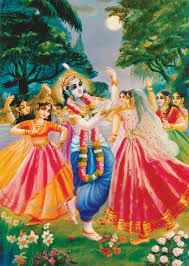
When the gopīs were talking in this way, their feelings for Kṛṣṇa became more and more intensified, and they were experiencing Kṛṣṇa’s smiling, Kṛṣṇa’s words of love, Kṛṣṇa’s attractive features, Kṛṣṇa’s characteristics and Kṛṣṇa’s embraces. By the force of their ecstatic feelings, it appeared to them that Kṛṣṇa was personally present and dancing before them. Because of their sweet remembrance of Kṛṣṇa, they could not check their tears, and they began to cry without consideration.
Lord Balarāma could, of course, understand the ecstatic feelings of the gopīs, and therefore He wanted to pacify them. He was expert in presenting an appeal, and thus, treating the gopīs very respectfully, He began to narrate the stories of Kṛṣṇa so tactfully that the gopīs became satisfied. In order to keep the gopīs in Vṛndāvana satisfied, Lord Balarāma stayed there continually for two months, namely the months of Caitra (March-April) and Vaiśākha (April-May). For those two months He kept Himself among the gopīs, and He passed every night with them in the forest of Vṛndāvana in order to satisfy their desire for conjugal love. Thus Balarāma also enjoyed the rāsa dance with the gopīs during those two months. Since the season was springtime, the breeze on the bank of the Yamunā was blowing very mildly, carrying the aroma of different flowers, especially of the flower known as kaumudī. Moonlight filled the sky and spread everywhere, and thus the banks of the Yamunā appeared to be very bright and pleasing, and Lord Balarāma enjoyed the company of the gopīs there.
The demigod known as Varuṇa sent his daughter Vāruṇī in the form of liquid honey oozing from the hollows of the trees. Because of this honey the whole forest became aromatic, and the sweet aroma of the liquid honey, Vāruṇī, captivated Balarāmajī. Balarāmajī and all the gopīs became very much attracted by the taste of Vāruṇī, and all of them drank it together. While drinking this natural beverage, Vāruṇī, all the gopīs chanted the glories of Lord Balarāma, and Lord Balarāma felt very happy, as if He had become intoxicated by drinking that Vāruṇī beverage. His eyes rolled in a pleasing attitude. He was decorated with long garlands of forest flowers, and the whole situation appeared to be a great function of happiness because of this transcendental bliss. Lord Balarāma smiled beautifully, and the drops of perspiration decorating His face appeared to be soothing morning dew.
While Balarāma was in that happy mood, He desired to enjoy the company of the gopīs in the water of the Yamunā. Therefore, He called Yamunā to come nearby. But Yamunā neglected the order of Balarāmajī, considering Him to be intoxicated. Lord Balarāma became very much displeased at Yamunā’s neglecting His order. He immediately wanted to scratch the land near the river with His plowshare. Lord Balarāma has two weapons, a plow and a club, and He takes service from them when they are required. This time He wanted to bring the Yamunā by force, and He took the help of His plow. He wanted to punish Yamunā because she did not come in obedience to His order. He addressed Yamunā: “You wretched river! You did not care for My order. Now I shall teach you a lesson! You did not come to Me voluntarily. Now with the help of My plow I shall force you to come. I shall divide you into hundreds of scattered streams!”
When Yamunā was threatened like this, she became greatly afraid of the power of Balarāma and immediately came in person, falling at His lotus feet and praying thus: “My dear Balarāma, You are the most powerful personality, and You are pleasing to everyone. Unfortunately, I forgot Your glorious, exalted position, but now I have come to my senses, and I remember that You hold all the planetary systems on Your head merely by Your partial expansion of Śeṣa. You are the sustainer of the whole universe. My dear Supreme Personality of Godhead, You are full of six opulences. Because I forgot Your omnipotence, I have mistakenly disobeyed Your order, and thus I have become a great offender. But, my dear Lord, please know that I am a surrendered soul unto You. You are very much affectionate to Your devotees. Therefore, please excuse my impudence and mistakes and, by Your causeless mercy, may You now release me.”
Upon displaying this submissive attitude, Yamunā was forgiven, and when she came nearby, Lord Balarāma wanted to enjoy the pleasure of swimming within her water along with the gopīs in the same way an elephant enjoys himself along with his many she-elephants. After a long time, when Lord Balarāma had enjoyed to His full satisfaction, He came out of the water, and immediately a goddess of fortune offered Him a nice blue garment and a valuable necklace made of gold. After taking bath in the Yamunā, Lord Balarāma, dressed in blue garments and decorated with golden ornaments, looked very attractive to everyone. Lord Balarāma’s complexion is white, and when He was properly dressed He looked exactly like the white elephant of King Indra in the heavenly planet. The Rver Yamunā still has many small branches due to being scratched by the plowshare of Lord Balarāma. And all these branches of the River Yamunā still glorify the omnipotency of Lord Balarāma.
Lord Balarāma and the gopīs enjoyed transcendental pastimes together every night for two months, and time passed away so quickly that all those nights appeared to be only one night. In the presence of Lord Balarāma, all the gopīs and inhabitants of Vṛndāvana became as cheerful as they had been before in the presence of both brothers, Lord Kṛṣṇa and Lord Balarāma.
Thus ends the Bhaktivedanta purport of the Second Volume, Tenth Chapter, of Kṛṣṇa, “Lord Balarāma Visits Vṛndāvana.” link to this page: https://prabhupadabooks.com/kb/2/10
Sri Vamsi Vadana Thakura avirbhava Tithi [appearance day] –Thursday, April 6,2023 – [Mayapura, West Bengal, Bharata Bhumi time]
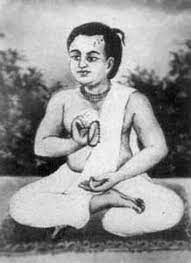

vamshi krishna-priya yasit sa vamshi-dasa-thakkurah
Vamshivadanananda Thakur was Krishna’s flute in Vraja.
(Gaura-ganoddesha-dipika 179)
The gopis praised the good fortune of Krishna’s flute, for he was able to constantly drink the nectar of Krishna’s lips. Everything in Vraja is spiritual, i.e., conscious, and so the flute could take human form as Sri Vamshivadanananda Thakur. His life story has been recounted by his grandson, Shrivallabha Das, in the book Vamshi-vilasa. Other books which contain details of his life are Shripata-paryatana and Bhakti-ratnakara, and the Gaudiya Vaishnava Abhidhana also gives a brief biography.
Vamshivadanananda Thakur was known by five names in Gaudiya Vaishnava society: Vamshivadana, Vamshidas, Vamshi, Vadana, and Vadanananda. He was a well-known writer of devotional songs. His appearance took place on the day of the spring full moon (in the month of Chaitra) in either 1416 (according to Vamshi-shiksha) or 1427 of the Shaka era (1495 or 1506 AD.).
Vamshivadanananda’s home in Nabadwip
In the Shripata-paryatana, the following information is given:
The two villages known as Kuliya and Pahariapura were side by side. Vamshivadana, Kavidatta and Saranga Thakur lived there. As the town grew, it was known as Kuliya Pahariapura.
Vamshivadanananda Thakur’s home was in Koladvipa, i.e., the present-day town of Nabadwip which was formerly known as Kuliya Pahariapura. Kuliya had four neighborhoods known as Teghari, Bneciyaria, Bedariaparia and Cinedanga. Shrikara Cattopadhyaya came from Bilvagrama to live in Bneciyaria. Amongst the descendants of Shrikara Cattopadhyaya was Yudhishthira Cattopadhyaya who had three sons: Madhava Das (nicknamed Chakarii), Hari Das (Tinakarii) and Krishnasampatti (Dukarii) Cattopadhyaya. Chakarii Cattopadhyaya was Vamshivadana’s father. His mother’s name was Candrakala Devi. When Mahaprabhu passed through Kuliya on his trip through Bengal which ultimately ended at Kanair Natashala, he stayed at Chakarii Cattopadhyaya’s house for seven days. During this time he gave his blessings to all the residents of Nabadwip and in particular to Devananda Pandit. This information comes from Kavi Karnapura’s Chaitanya-candrodaya Nataka.
It is said that both Mahaprabhu and Advaita Acharya were present when Vamshivadanananda was born. After Mahaprabhu took sannyas, Vamshivadanananda was engaged as Sachi Mata and Vishnupriya’s servant and protector. When Srinivas Acharya came to Nabadwip to see the Lord’s family, Vamshi embraced him emotionally. This is described in the Bhakti-ratnakara:
Though he had not been introduced, Vamshivadanananda guessed that this must be Srinivas. He approached him and asked him who he was. Srinivas told him everything about himself. Vamshivadanananda embraced him and washed his body with his tears. Srinivas wanted to fall to the ground and pay obeisances to Vamshi Thakur, but Vamshi would not let him. He then went and told Vishnupriya Ishvari and Sachi Ma that Srinivas had come. (Bhakti-ratnakara 4.20-24)
Vamshivadanananda Thakur lived as a householder. He had two sons, Chaitanya Das and Nityananda Das. His deity’s name was Pranavallabha. Later, at Vishnupriya Devi’s request, he established the worship of the Mahaprabhu deity. He also worshiped the Gopinath deity of his forefathers. He spent the last part of life in his ancestral village of Bilvagrama. The Bhattacharyas of that village are said to be his descendants.
Ramai Thakur
Vamshivadanananda Thakur’s grandson, the son of Chaitanya Das, was named Sri Ramachandra or Ramai Thakur. He found deities of Rama and Krishna deities at Praskandana Tirtha in Vrindavan [FN: Praskandana Tirtha is the Yamuna ghata which is not far from Dvadashaditya Öila. It is said that when Krishna fought with Kaliya in the middle of the Yamuna, he caught cold in the water. When he came out, all the twelve Adityas appeared simultaneously and warmed him up. Krishna became so hot that he started to sweat. His sweat flowed down and merged with the water of the Yamuna at the place known as Praskandana Tirtha.] and then brought them to Baghna Paria in Burdwan district. They are known ar Sri-Rama-Kanai. Sri Shyamananda Panditaavirbhava Tithi [appearance day] –Thursday, April 6,2023 – [Mayapura, West Bengal, Bharata Bhumi time]
Sri Shyamananda Pandita
Sri Shyamananda Prabhu was a servant of a servant of Subala in Krishna-lila. He was the disciple of Hridayananda or Hriday Chaitanya, who was a disciple of Gauri Das Pandit. Gauri Das was Subala in Krishna-lila.
yam loka bhuvi kirtayanti hridayanandasya shishyam priyam
sakhye shri-subalasya yam bhagavatah preshthanushishyam tatha
sa shriman rasikendra-mastaka-manish citte mamaharnisham
shri-radhapriya-narma-marmasu rucim sampadayan bhasatam
Sri Shyamananda was known in this world as Hridayananda’s dear disciple; he was the grand-disciple of Subala sakha, the most dear friend of the Supreme Lord; he was the crest-jewel of the enjoyers of sacred rapture. May he appear day and night in my mind, bringing an appreciation for the essence of the joys of the beloved of Sri Radha.
(Shyamananda-shataka)
Shyamananda Prabhu was born on the full moon day of Chaitra in 1456 of the Shaka era (1534 AD) in the town of Dharenda Bahadurpura, which is near the Kharigapura railway station in Medinipura. His father was Sri Krishna Mandal and his mother, Durika. Krishna Mandal’s home town was Dandeshvara which lies on the banks of the Suvarnarekha River. The following statement is found in the Gaudiya Vaishnava Abhidhana: “Sri Krishna Mandal used to live in a place called Ambuwa, near Dandeshvara. He formerly lived in Gauda (the part of Bengal which lies on the banks of the Bhagirathi River) and only later moved to Dandeshvara, is just across the present-day border in Orissa. Shyamananda’s disciples have established five principle seats in the towns of Dharenda, Bahadurapura, Rayani, Gopiballabhapura, and Nrisinghapura.”
Shyamananda Prabhu was born in the Sadgopa subcaste, which fits in the category of jala-cala, i.e., Brahmins are permitted to take water touched by its members. Of course, a Vaishnava is beyond the material qualities and may take birth in a family of any race or caste. If anyone thinks badly of Vaishnavas or judges them on the basis of their race or caste is destined for hell.
arcye shiladhir gurushu naramatir vaishnave jati-buddhir
vishnor va vaishnavanam kali-mala-mathane padatirthe’mbubuddhih
shrivishnor namni mantre sakala-kalushahe shabda-samanya-buddhir
vishnau sarveshvareshe tad-itara-samadhir yasya va naraki sah
Anyone who considers the deity to be nothing but stone, the guru to be an ordinary human being, or the Vaishnava to be a member of a particular caste or race, who takes the holy water which has washed Vishnu or the Vaishnava’s feet and can destroy all the sins of the age of Kali, to be ordinary water, who thinks that the name or mantra of Vishnu, which destroys all evils, is the same as any other sound, or who takes Vishnu to be equal to anything other than him, has a hellish nature. (Padma-purana)
One who takes birth in a low-class family is not disqualified from performing devotional service, nor is one who born in a pure, high-class brahmanical family automatically qualified for such service. Whoever engages in the worship of the Lord is a great person; one who does not worship is rejected. (Chaitanya Charitamrita 3.4.66-7)
na me bhaktash caturvedi mad-bhaktah shvapacah priyah
tasmai deyam tato grahyam sa ca pujyo yatha hy aham
Simply being a knower of the four Vedas does not make someone my devotee. An outcaste who is my devotee is dear to me. One should exchange gifts and food, etc., with such a devotee for he is verily as worshipable as I. (Quoted in Haribhaktivilasa.)
Prior to Shyamananda’s birth, his parents had lost several children in childbirth and they vowed to surrender their next child to Vishnu if it survived. Having suffered so much grief in the loss of their previous children, they first named Shyamananda Duhkhi, or “unhappy”, to ward off further distress.
Shyamananda’s parents Durika and Shrikrishna Mandala made their home in Dandeshvara, his. His father was the best of the Sadgopa caste, of impeccable character. Krishna was everything to him and Krishna’s devotees very dear. We cannot describe the virtues of his parents for fear of increasing the volume of this book. They had previously lived in Dharenda and Bahadurapura and some people say that Shyamananda’s birth took place there. Nothing could stop his birth, for he came after many other children had been still-born to his parents. Because of their previous losses, his parents brought him up in sadness and so they called him Duhkhi. (Bhakti-ratnakara 1.351-5, 359)
Shyamananda Prabhu’s parents performed the appropriate rituals when the time came: the first eating of solid food, the cutting of hair, etc. As he grew older, he studied Sanskrit grammar, etc. His parents were overjoyed to see his talents and his religious proclivity. After having carefully listened to the glories of Gauranga and Nityananda from devotees, he was able to repeat them to others. When listening to the activities of Gaura-Nitai or those of Radha and Krishna, tears would flow in waves from his eyes. He also devotedly served his parents and they told him to get initiated so that he could fully commit himself to the service of the Lord. Duhkhi agreed and told them that he wished to take diksha from Hriday Chaitanya, the disciple of Nityananda and Gauranga’s associate, Gauri Das Pandit. When going to Kalna for that purpose, he would also have the good fortune to see the Ganges and to bathe in it His parents happily gave him permission to go there.
When Duhkhi arrived in Ambika Kalna, he threw himslf at the feet of Hriday Chaitanya, who upon learning his identity, happily gave him Krishna-mantra and named him Krishna Das. From then on Duhkhi was known as Duhkhi Krishna Das. Hriday Chaitanya ordered him to go to Vrindavan to engage in bhajana. Though he did not like being separated from his gurudeva, Duhkhi Krishna Das set off for Vraja, first visiting Nabadwip and other places in Gaudamandala where he sought the blessings of the Vaishnavas. Finally, after spending much time on pilgrimage, he finally arrived in Vrindavan where he became completely absorbed in the worship of Radha and Shyamasundar.
In Vrindavan, Duhkhi Krishna Das studied the Vaishnava scriptures under Sri Jiva Goswami, who was the leading scholar of the sampradaya. When Hriday Chaitanya heard of the enthusiasm with which Duhkhi Krishna Das was leading the devotional life in Vraja, he wrote a letter to Jiva Goswami in which he said that Duhkhi should consider Jiva to be an extension of himself. Jiva gave titles to his three most prominent students, Srinivas, Narottama and Duhkhi Krishna Das, bestowing Shyamananda on the latter. The reasoning behind this name was that he brought great joy to Radha and Shyamasundar.
While in Vrindavan, he was given the name Shyamananda because he brought great joy to Shyamasundar. When Jiva saw his charming activities, he kept him nearby and instructed him in the Vaishnava scriptures. (Bhakti-ratnakara 1.401-2)
Jiva Goswami sent Srinivas Acharya, Narottama Das Thakur and Shyamananda back to Bengal with the Vaishnava scriptures in 1504 of the Shaka era (1582-3 AD). The idea was to spread the teachings found in these books throughout Bengal and Orissa. The events which took place when Vira Hambira had the books stolen in Vishnupura have been related in the chapter on Srinivas Acharya.
Narottama went to northern Bengal and Shyamananda went to Orissa. Midnapore district was previously under the rule of the Orissan king. Today there is a branch Gaudiya Math in Midnapore city named the Shyamananda Gaudiya Math which is meant to preserve his holy memory.
Radharani’s special mercy on Shyamananda
Even though Shyamananda Prabhu was Hriday Chaitanya’s initiated disciple, his guru had entrusted him to the care of Jiva Goswami Prabhu. Through the association of Jiva and service to him, Shyamananda developed a taste for serving Radha and Krishna in the conjugal mood. Hriday Chaitanya Prabhu himself was a disciple of Gauri Das Pandit, who was one of the twelve Gopals, Subala sakha. He worshiped Gaura-Nitai in the mood of friendship. Those who think that Shyamananda committed an offense to his initiating spiritual master by abandoning his mood and trying to directly serve Krishna in a higher mood, are wrong. The mood of friendship is contained within the conjugal mood. If a disciple makes further progress in spiritual life it enhances the reputation of his teacher.
An extraordinary incident, which took place in Vrindavan prior to his being ordered by Jiva to return to Orissa, demonstrates how dear Shyamananda was to Radharani. One day, Shyamananda Prabhu was sweeping the Rasa-mandala in Vrindavan, absorbed in ecstatic trance. Suddenly, by Radharani’s transcendental mercy, he found her ankle bracelet lying on the ground. In his excitement, he touched the ankle bracelet to his forehead, where it left a mark which is preserved to this day as the tilaka marking of the disciple descendants of Shyamananda. It is known as nupura-tilaka.
Shyamananda Prabhu’s preaching
Narottama Thakur and Shyamananda primarily preached the message of Mahaprabhu through kirtan. Srinivas sang kirtan in a style called Manohara-sahi, Narottama in Gariana-hati, and Shyamananda in Reneti. He would enchant the listeners with his heartfelt singing of kirtan. These styles of kirtan are no longer extant.
As a result of his preaching in Orissa, many Muslims also became Shyamananda’s disciples. The most important of his innumerable disciples was Rasika Murari. Rasikananda was the son of Achyutananda, the zamindar of Rohini village. He had another name, Murari, and was thus most commonly known as Rasika Murari. He was a very powerful preacher and his fame is still widespread through the villages of Orissa. A list of some of Shyamananda’s prominent disciples is given in the Bhakti-ratnakara:
Shyamananda made disciples all over the place. A person can be purified by hearing their names: Radhananda, Purushottam, Manohara, Cintamani, Balabhadra, Jagadishvara, Uddhava, Akrura, Madhuvana, Govinda, Jagannath, Gadadhara, Anandananda, and Radhamohana. Shyamananda was constantly immersed in the joys of kirtan in the association of these disciples. Poets have described his wonderful pastimes for the pleasure of everyone. (Bhakti-ratnakara 15.62-66)
Other than these disciples, Shyamananda converted a yogi named Damodar. Narahari Chakravarti has written the following account of that conversion:
There was a practitioner of yoga named Damodar. Shyamananda mercifully flooded him with devotional rasa. After becoming Shyamananda’s disciple, Damodar cried and chanted the names of Nitai-Chaitanya. Who could remain untouched by his ecstatic absorption. He danced, crying out “bhakti is the best of all!” After delivering Damodar, Shyamananda continued to travel about, distributing the jewel of devotion to all. (Bhakti-ratnakara 15.55-8)
Shyamananda put on a large festival at Dharenda with Rasika Murari and Damodar which is still remembered today. When he left the world, Shyamananda turned over the service of Govinda at Gopivallabhapura. Shyamananda’s disciples and their descendants still worship his deity Radha-Shyamasundar in Vrindavan. This temple is still one of the principle pilgrimage sites in Vrindavan.
Shyamananda Prabhu lived the last part of his life in Nrisinghapura in Orissa where he continued preaching Vaishnavism. His earthly pastimes came to an end on the first day of the waning moon in the month of Asharh in 1552 of the Shaka era (1630 AD).