
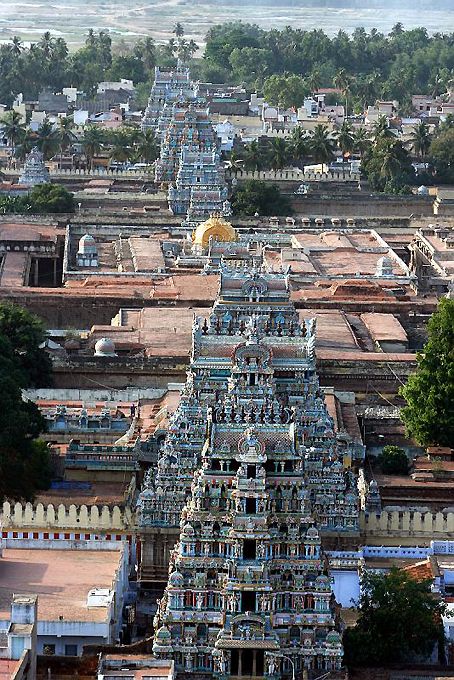
Śrī Raṅga-kṣetra (Śrī Raṅgam) is a very famous place. It lies in the district of Tiruchchirāpalli, about ten miles west of Kumbhakonam and near the city of Tiruchchirāpalli, on an island in the Kāverī River. The Śrī Raṅgam temple is the largest in India, and there are seven walls surrounding it. There are also seven roads leading to Śrī Raṅgam. The ancient names of these roads are the road of Dharma, the road of Rājamahendra, the road of Kulaśekhara, the road of Ālināḍana, the road of Tiruvikrama, the Tirubiḍi road of Māḍamāḍi-gāisa, and the road of Aḍa-iyāvala-indāna. The temple was founded before the reign of Dharmavarma, who reigned before Rājamahendra.
CC Madhya 9.79, Translation and Purport
After visiting the holy place named Śiva-kṣetra, Caitanya Mahāprabhu arrived at Pāpanāśana and there saw the temple of Lord Viṣṇu. Then He finally reached Śrī Raṅga-kṣetra.
There are two holy places known as Pāpanāśana: one is located eight miles southwest of Kumbhakonam, and the other lies near the river Tāmraparṇī, in the district of Tirunelveli, twenty miles west of the city of Tirunelveli (Pālamakoṭā).
Śrī Raṅga-kṣetra (Śrī Raṅgam) is a very famous place. It lies in the district of Tiruchchirāpalli, about ten miles west of Kumbhakonam and near the city of Tiruchchirāpalli, on an island in the Kāverī River. The Śrī Raṅgam temple is the largest in India, and there are seven walls surrounding it. There are also seven roads leading to Śrī Raṅgam. The ancient names of these roads are the road of Dharma, the road of Rājamahendra, the road of Kulaśekhara, the road of Ālināḍana, the road of Tiruvikrama, the Tirubiḍi road of Māḍamāḍi-gāisa, and the road of Aḍa-iyāvala-indāna. The temple was founded before the reign of Dharmavarma, who reigned before Rājamahendra. Many celebrated kings like Kulaśekhara and Yāmunācārya (Ālabandāru) resided in the temple of Śrī Raṅgam. Yāmunācārya, Śrī Rāmānuja, Sudarśanācārya and others also supervised this temple.
The incarnation of the goddess of fortune known as Godādevī or Śrī Āṇḍāl was one of the twelve Ālvārs, liberated persons known as divya-sūris. She was married to the Deity of Lord Śrī Raṅganātha, and later she entered into the body of the Lord. An incarnation of Kārmuka named Tirumaṅga (also one of the Ālvārs) acquired some money by stealing and built the fourth boundary wall of Śrī Raṅgam. It is said that in the year 289 of the Age of Kali, the Ālvār of the name Toṇḍaraḍippaḍi was born. While engaged in devotional service he fell victim to a prostitute, and Śrī Raṅganātha, seeing His devotee so degraded, sent one of His servants with a golden plate to that prostitute. When the golden plate was discovered missing from the temple, there was a search, and it was found in the prostitute’s house. When the devotee saw Raṅganātha’s mercy upon this prostitute, his mistake was rectified. He then prepared the third boundary wall of the Raṅganātha temple and cultivated a tulasī garden there.
There was also a celebrated disciple of Rāmānujācārya’s known as Kūreśa. Śrī Rāmapillāi was the son of Kūreśa, and his son was Vāgvijaya Bhaṭṭa, whose son was Vedavyāsa Bhaṭṭa, or Śrī Sudarśanācārya. When Sudarśanācārya was an old man, the Muslims attacked the temple of Raṅganātha and killed about twelve hundred Śrī Vaiṣṇavas. At that time the Deity of Raṅganātha was transferred to the temple of Tirupati, in the kingdom of Vijaya-nagara. The governor of Gingee, Goppaṇārya, brought Śrī Raṅganātha from the temple of Tirupati to a place known as Siṁha-brahma, where the Lord was situated for three years. In the year 1293 Śaka (A.D. 1371) the Deity was reinstalled in the Raṅganātha temple. On the eastern wall of the Raṅganātha temple is an inscription written by Vedānta-deśika relating how Raṅganātha was returned to the temple.
Sri Caitanya-caritamrta
CC Adi-lila
In the year 1433 Śakābda (A.D. 1511), when Lord Caitanya Mahāprabhu was touring South India, He stayed for four months during the period of Cāturmāsya at the house of Veṅkaṭa Bhaṭṭa, who then got the opportunity to serve the Lord to his heart’s content. Gopāla Bhaṭṭa also got the opportunity to serve the Lord at this time. Śrī Gopāla Bhaṭṭa Gosvāmī was later initiated by his uncle, the great sannyāsī Prabodhānanda Sarasvatī.
CC Adi 10.105, Translation and Purport
Śrī Gopāla Bhaṭṭa Gosvāmī, the forty-seventh branch, was one of the great and exalted branches of the tree. He always engaged in discourses about love of Godhead in the company of Rūpa Gosvāmī and Sanātana Gosvāmī.
Śrī Gopāla Bhaṭṭa Gosvāmī was the son of Veṅkaṭa Bhaṭṭa, a resident of Śrī Raṅgam. Gopāla Bhaṭṭa formerly belonged to the disciplic succession of the Rāmānuja-sampradāya but later became part of the Gauḍīya-sampradāya. In the year 1433 Śakābda (A.D. 1511), when Lord Caitanya Mahāprabhu was touring South India, He stayed for four months during the period of Cāturmāsya at the house of Veṅkaṭa Bhaṭṭa, who then got the opportunity to serve the Lord to his heart’s content. Gopāla Bhaṭṭa also got the opportunity to serve the Lord at this time. Śrī Gopāla Bhaṭṭa Gosvāmī was later initiated by his uncle, the great sannyāsī Prabodhānanda Sarasvatī. Both the father and the mother of Gopāla Bhaṭṭa Gosvāmī were extremely fortunate, for they dedicated their entire lives to the service of Lord Caitanya Mahāprabhu. They allowed Gopāla Bhaṭṭa Gosvāmī to go to Vṛndāvana, and they gave up their lives thinking of Śrī Caitanya Mahāprabhu. When Lord Caitanya was later informed that Gopāla Bhaṭṭa Gosvāmī had gone to Vṛndāvana and met Śrī Rūpa and Sanātana Gosvāmī, He was very pleased, and He advised Śrī Rūpa and Sanātana to accept Gopāla Bhaṭṭa Gosvāmī as their younger brother and take care of him. Śrī Sanātana Gosvāmī, out of his great affection for Gopāla Bhaṭṭa Gosvāmī, compiled the Vaiṣṇava smṛti named Hari-bhakti-vilāsa and published it under his name. Under the instruction of Śrīla Rūpa and Sanātana, Gopāla Bhaṭṭa Gosvāmī installed one of the seven principal Deities of Vṛndāvana, the Rādhāramaṇa Deity. The sevaits (priests) of the Rādhāramaṇa temple belong to the Gauḍīya-sampradāya.
When Kṛṣṇadāsa Kavirāja Gosvāmī took permission from all the Vaiṣṇavas before writing Śrī Caitanya-caritāmṛta, Gopāla Bhaṭṭa Gosvāmī also gave him his blessings, but he requested him not to mention his name in the book. Therefore Kṛṣṇadāsa Kavirāja Gosvāmī has mentioned Gopāla Bhaṭṭa Gosvāmī only very cautiously in one or two passages of the Caitanya-caritāmṛta. Śrīla Jīva Gosvāmī has written in the beginning of his Tattva-sandarbha, “A devotee from southern India who was born of a brāhmaṇa family and was a very intimate friend of Rūpa Gosvāmī and Sanātana Gosvāmī has written a book that he has not compiled chronologically. Therefore I, a tiny living entity known as jīva, am trying to assort the events of the book chronologically, consulting the direction of great personalities like Madhvācārya, Śrīdhara Svāmī, Rāmānujācārya and other senior Vaiṣṇavas in the disciplic succession.” In the beginning of the Bhagavat-sandarbha there are similar statements by Śrīla Jīva Gosvāmī. Śrīla Gopāla Bhaṭṭa Gosvāmī compiled a book called Sat-kriyā-sāra-dīpikā, edited the Hari-bhakti-vilāsa, wrote a foreword to the Ṣaṭ-sandarbha and a commentary on the Kṛṣṇa-karṇāmṛta, and installed the Rādhāramaṇa Deity in Vṛndāvana. In the Gaura-gaṇoddeśa-dīpikā (184) it is mentioned that his previous name in the pastimes of Lord Kṛṣṇa was Anaṅga-mañjarī. Sometimes he is also said to have been an incarnation of Guṇa-mañjarī. Śrīnivāsa Ācārya and Gopīnātha Pūjārī were two of his disciples.